Tuesday, February 21, 2012

That's Life. Street photography in India.

That's Life is a collective of street photographers who capture life on the streets of India in fresh and unusual ways that tell interesting and sometimes humorous stories. That's Life was set up not only to showcase the work of these photographers but to promote this real and honest genre of photography.

Street photography is an emerging art form in India. While extremely personal and subjective, it is probably the hardest to do. It is an unadulterated documentation of life … history if you will.

If nothing else, the images in "That's Life"  will prove that there is so much happening around us at all times, so many fleeting but special moments which often pass by unnoticed. Hopefully "That's Life" will open your eyes and your mind to the amazing possibilities unfolding on the streets of India every day.

©Arindam Thokder
Hi Kaushal, tell us few words  about your new street photography collective, "That's life". How this idea came alive?

Hi Andreas. I have been shooting on the streets of India for a few years, but it took a long time for my work to get noticed. Gaining confidence from some prominent international street photographers like David Gibson and Richard Bram, and with a nudge from my friend and fellow street photographer Eric Kim, I decided to try and form a collective. There are a lot of talented street photographers in India who continue to shoot in a bubble and often go unnoticed. As a collective we can wield more power and gain more exposure.

  ©Kaushal Parikh

What is your purpose as collective, I mean what do you think you could achieve better  as collective than as individual photographers.

India is a diverse country and the streets are very unique and different from the West.  In fact the streets within India are very different when you go from the larger cities to the small towns.  As a collective we hope to showcase work from across India in different personal styles and expressions that will add interest to the fascinating scenes that unfold in the streets on a daily basis.  With a group of like-minded people, all passionate about street photography, I am sure we will be able to promote the amazing work created in the streets of this diverse country.

©Prantik Mazumder

You started this group only four and now you are seven. What is your plan for the future?

We currently have 7 very talented photographers, all with a very personal style and mostly from different professional backgrounds.  I think there are only two full time photographers. 
To start with we hope to reach at least 10 members in the next few months.  The search for talent is on but we want to keep membership very selective to maintain a certain standard of what we think is good street photography. 
The future has many possibilities and some of the ideas that I don’t mind talking about presently include participating in international photography festivals like the LSFP, having That’s Life exhibitions, and conducting workshops etc. to increase the awareness of street photography.

©Suyog Gaidhani

Is there any prerequisite  in a style of  a photographer to be member in your group or is it enough to be a good street photographer shooting in India. I mean do you after a specific style,  aesthetics  or in the opposite you ask for  different styles in your group?

I think the most important thing is to be a good street photographer.  As far as style goes there is no fixed aesthetic we are looking for.  In fact the more diverse our members, both geographically and aesthetically, the better.  And what is cool is that if we have two or three members from the same city but with different styles it will give viewers different viewpoints of the same city that can be very interesting.

 ©Prashant Godbole

When most of the people think of India they think of a place with strong juxtapositions and very crowded. Do you want as group to make this image stronger or show something else?

When shooting in India it is very hard to avoid juxtapositions and crowds, but at the same time if someone can show a different side to the streets of this country we will welcome that point of view.  In fact the existing portfolios already showcase a mix of busy images, quiet images, images that emphasize light and shadow, juxtapositions, humour, b&w and colour.  We don’t want to force any particular style.  The only thing we are adamant about is good and meaningful imagery.

 ©Mark Carey

Why a street photographer must come and shoot in India's streets? What makes India different than the rest of the world in your opinion.

If by the rest of the world you mean cities like NY, Paris, London which are the home for street photography, then India is a world apart in so many ways.  The streets are crowded and not very clean.  There is excessive poverty on the streets.  These things make it very challenging to create an aesthetically pleasing image but also offer the possibility of creating work that is fresh.  Having said that photographing on the streets of India is far less stressful because the people are a lot warmer and more open to being photographed.  In all my years shooting on the streets I can barely remember a few instances where I was asked not to make an image.  Of course the key is to maintain a respect for your subjects and not exploit underprivileged people in unbecoming circumstances.  A sincere outlook and a smile on the streets of India go a long way.

 ©Amit Chakravarty

I have seen many pictures from India from dozens photographers. How easy or difficult is to be unique as a photographer in such a scenery as India is.

To be unique in India is probably as difficult as being unique in Cuba, Turkey, the UK or any other extensively photographed country in the world.  That is where you can separate the good photographers from the street snappers.  The good ones can isolate a scene in a crowd and capture it in a way that is reflective of their personal expression.  People see things differently so the challenge lies in translating your view of the world onto film.  If done accurately then it will most likely be unique.

©Arindam Thokder

Is there anything else you'd like to add about your group ?

I would just like to thank you, Andreas, for giving us this platform to talk about our collective.  That’s Life will hopefully become the default site that anyone will visit when they want to view street photography created on the streets of India.
Visit us at www.thatslife.in.
Cheers!

Thank you very much, I wish you all the best and I'm looking forward seeing even more interesting things from India and your collective.


Sunday, January 29, 2012

Andreas Paradise. An Interview

No my friends, I'm not taking my self an interview :-) This blog as my readers know is not actually about my photography but about my thoughts and my interests in photography. So, Alex Coghe has given me the opportunity to express some of my thoughts in photography.

His blog is specialized in street photography so my answers was given in that in mind but photography has values which exist in every kind of photography.

I will copy just the two first questions about what is street photography for me and what the photography of Andreas Paradise is looking for and I will sugest you not only to read the rest of the interview but to search the rest of the blog "in35mm" for interesting infos in street photography and some more interesting interviews from other photographers

Hello Andreas, we start this interview with a classic question: street photography for you is...

Hi Alex, street photography is for me a way not only to see but also to feel the fellow people, the world, the everyday reality, the small details which engulf us in public places but which I couldn't see before starting to shoot in the streets or before starting to enjoy the good sp of other photographers. Street photography is a way to discover an invisible world, a parallel odd world which coexist with the boring one we all know.

And the photography of Andreas Paradise what is looking for?

I could say that my photography is looking for my truth. My truth of how the world is or could be. But of course this truth is a big lie after all. But don't forget that photos say true things with lies.

The rest of the Interview is here http://in35mm.blogspot.com/2012/01/beyond-obvious-interview-with-andreas.html

Monday, December 5, 2011

Blake Andrews. An Interview

Blake Andrews is a great photographer member of In-Public. He lives with his wife and their three sons in Eugene, Oregon. You can find more of his photos in his site www.blakeandrewsphoto.com You can also find more of his thoughts in his great blog blakeandrews.blogspot.com


Please tell us something about yourself. When and how did you start photography? How did you first get started in street photography?

I took a photography class in 1993 and that kindled my interest. From that point I took photos on my own and gradually became more and more enamored. I was living in a city at the time, exploring with a camera, so most of what I shot early on might fall under the "street photography" label. But I didn't consciously set out to shoot that style. I didn't even know what street photography was until I'd been shooting for several years. And even now "street photography" is not a perfect description for what I do.


Which contemporary or emerging photographers impress you?

I've been asked this question a few times so I'l try to pick people I haven't yet mentioned. Matt Eich. Garry Trinh. Thomas Michael Alleman. Jon Lowenstein. Masao Yamamoto. Jason Fulford. Gordon Stettinius. Ron Jude. Michael Ackerman. Vanessa Winship. Simon Kosoff. Caleb Charland. Ed Panar.


Which of the old Masters inspired you the most?

Same logic. Some of these folks are still quite active, so the word "old" doesn't quite apply, but they are all masters: Tony Ray-Jones. Sylvia Plachy. Ed Ruscha. Philip Perkis. Saul Leiter. Paul McDough. Barbara Crane. Louis Faurer. Helen Levitt. Henry Wessel. Charles Traub. Nicholas Nixon. Tom Wood. Mitch Epstein.


What is your favorite project till now and why?

I don't really work in projects but if I'm thinking in that way, I suppose my family photos make a nice body of work. It's probably the only work that I've done that I'm assured will have lasting meaning for someone in the future: my kids. They grow and change so quickly that the photos become historic in a hurry, and I kind of like that.


There are a lot of differing opinions when it comes to defining “street photography.” How would you define it? What is your opinion about street photography without life (not necessarily human). Documentary vs street photography. How close or how far apart do you think they are?

I was asked this question recently by someone else (http://jophilippe.wordpress.com/2010/11/01/interview-with-blake-andrews/) and I think my answer then still applies:
"I would define street photography as making unplanned photos in an unpredictable environment. That’s not exactly the same as documentary photography, which basically includes any photograph attempting to depict the world in a direct and real way."
An unpredictable environment can be one with life or without. Usually life adds to the uncertainty, but it's very possible to find chance moments without life.


How do you define “beauty” when it comes to photography?

That's a loaded question because I think beauty is extremely subjective. For me it's often tied to imperfection. I'm not so interested in perfect scenes in the style of Ansel Adams or Edward Weston. I think photos with flaws are more beautiful, because that's what the world looks like. It isn't perfect. It's got buck teeth. People who've had braces having boring teeth.
On one of Dylan's early records there's a song which starts, gets messed up, and then breaks down into him laughing. I think it's great that they left that in the recording, because if it was being recorded today I think that may have been smoothed over or erased in the name of "beauty". I like photos which operate by the same principle. Some of Winogrand's slanting shots feel like that. You're not supposed to hold the camera that way, which makes them appealing for me. After you look at a few of them you forget about the slant. I think this explains also the appeal for me of Holga and Diana work, although much of that work fetishizes the imperfect. But when it's done well it can be really nice.

Do you feel sometimes that your blogging activity maybe competes with your photography? I mean your blog is so successful that when people think of Blake Andrews do they first think of him as a blogger or as photographer?

It depends which audience you're talking about. In the online world I'm probably better known as a blogger because that's where I've put my online energy. I don't post many photos online but I keep the blog fairly active. So if you ask someone in Asia or Europe, or someone who only knowns me online, that's probably who I am to them.
But in the real world I'm known primarily as a photographer. My photographer friends don't pay much attention to my blog. I share photos with them and shoot with them and they know me as someone behind a camera, not necessarily a computer. And that's what I consider myself first and foremost, a shooter.


What is your relation with social networks like Facebook or Flickr, do we live in picture overdose times?

I enjoy Facebook but for me it doesn't have much practical application. It's just a fun amusement to check in on occasionally. It's been interesting to follow FPN on Facebook, not necessarily because the posts always lead to interesting discussions but because they're sort of a temperature check. They show what's on people's minds.
I don't post photos on Flickr so I can't comment on that aspect of it. I drop in occasionally on Flickr chat forums like HCSP. Sometimes they can be interesting.


Do you think that social networks can help a photographer by making him popular - well known - or is there a danger of making him after the "likes" of public and not really express himself.

I think it's very valuable to find colleagues who can give feedback and whose opinion you trust. Whether you find this online or in the real world doesn't matter, but I think that sort of feedback is vital, because otherwise photography can be quite isolating. For myself I rely mostly on real-world feedback. I have 4 or 5 friends who I meet with regularly to share work. I value their comments, and I think they value mine.
I think one potential pitfall of online feedback is that it's hard to know how to value it. If a photo gets 10 "likes" from strangers, that doesn't tell you very much. But one "like" from a trusted friend can be very informative. So if you can cultivate trusted colleagues online, that's valuable.
But in the end, feedback is feedback. The only judge that really matters is yourself. It sounds like a cliche but it's true.

Street photography has become wildly popular, What do you think the future is? What is the role of groups like inPublic or HCSP?

I'm not sure I agree with the premise. Everyone says street photography is popular but I think that depends where you look. Walk down the street and ask the first person you run into to name any street photographer. Or any photographer period. Street photography is an incredibly small niche in the grand scheme of things. Even in the photography world, which I think is what your question refers to, street photography is a minor footnote. Most fine art photography doesn't treat it seriously.
I think where it is popular, especially among beginners, is on the internet, simply because street is the most accessible form of photography, and the internet is the most accessible forum. All you need is a camera and walking shoes, and at the end of the day, a computer to post images. On the one hand this is great. It's never been easier to share work, and perhaps it's easier for street photographers to find and develop their voice now. I think street photography more than most other photographic forms has boomed online. But I think there's a risk of mistaking all of that online energy for real-world impact. At the end of the day, how many world class street photographers are there now compared to 30 years ago? My guess is roughly the same number.
A good example of online energy is the Street Photography Now book, which I think attempted to encapsulate the contemporary street photography zeitgeist. It did that to an extent, but I think what it did even better is give written form to the online street photo scene. To me the book seemed built around the internet, and sort of confirmed my view that the online world dominates street photography.
As for the future, I'm not sure. Things are changing quickly, but I suspect that in 30 years there will probably be roughly the same number of world class street photographers around as there are now.


Street Photography Now project was a great success last year. This year the community continues the project by self organizing. You are one of this year's instructors. What is your advice to the community?

Even though I submitted an instruction, I am rather dubious about learning via instruction. I've never had training in photography or taught it. I'm a great believer in practical experience. So my advice would be to treat these instructions as a fun activity but not with the expectation that they'll lead to anything. The path that leads forward is daily practice. Thousands of hours.


 Form, content, candid moment, the transformation of reality, all of these should be balanced in a good street photo, but what do you enjoy the most in good street photography?

I like photos which make you ask yourself, "How did they see that?" Those are the ones I enjoy most. Most photographs are fairly simple to decode. It's the ones which aren't which I find entertaining.

Living in a smaller town (Eugene, Oregon) like you have done in last few years, how has that influenced your work?

I've slowed my shooting since moving to Eugene. In some ways this has been a good thing. Living in a larger city I was a bit out of control. Although I learned quite a bit by constantly photographing, it was unmanageable. I never could've started my blog in Portland, for example. There just wasn't time. So the move to a community where shooting isn't a continual temptation has been a relief in some ways. Now I time my outings for certain places or certain events. The parade on Saturday or the tailgate scene or whatever. When I want a dose of urban life I go to Portland or plan strictly photographic outings to distant cities. I still have my camera with me between those times but the shooting isn't as constant. As I alluded to in my definition above, street photography can happen anywhere. It's "making unplanned photos in an unpredictable environment."


I know you are a film supporter. As they say there is no point in changing a winning team. When do you expect that digital will offer you something more than convenience (as you mention in another interview).

I'm not necessarily a film supporter. I shoot film but I'm happy for others to choose whatever format works for them. It's a personal decision. At this point I don't envision switching to digital, at least not for black and white. If I run out of things to say with b/w I might switch to color, at which point I'd look hard at digital. But for now I'm glad to do what I do. I've never taken a b/w film image and thought, "Darn, I wish I'd shot that in color digital." Instead it's been the other way. In those rare times I've been without my film camera I've regretted it.


Blake thank you very much for this interesting interview.


Tuesday, November 29, 2011

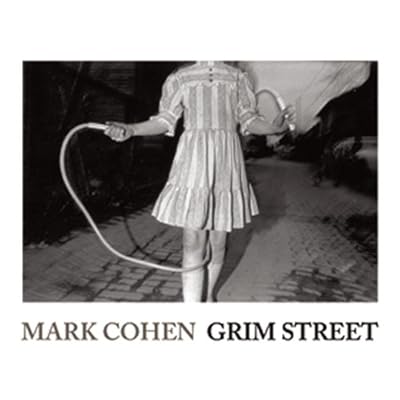
Mark Cohen. Grim Street

Mark Cohen first came to the attention of the photography world in 1973 with a solo exhibition at the Museum of Modern Art, New York. This iconic show proved to the art world that Cohen was the heir apparent to the explosive street photography of the 60s. Now, after more than thirty years, Cohen’s complex and influential body of work is presented for the first time in Grim Street, an astonishing collection of Americana as original and effective as the work of Robert Frank, Garry Winogrand, or Weegee.


Cohen’s photography confronts the viewer with a startling beauty, rapidly shifting from rough and confrontational to quiet, respectful, and serene. In Grim Street, filled with what Cohen calls “grab shots,” you can easily imagine the photographer guilefully patrolling the streets of Wilkes-Barre, the Pennsylvania mine-town he calls home. His camera, often prefocused and shot from the hip, scrolls around its subjects searching for tidbits of delectable detail. Then suddenly thrusting out towards its subjects, a strobe bursts, capturing a violently cropped spot of stockinged legs creeping around a corner, or a woman’s bared teeth and stretched lips. In these images emerges a cluttered world of visceral, sexualized encounters with the human body.


The photographs are equally fascinating for the inconsistent reaction of their subjects. In one shot, a group of young girls hide their faces with their coats and cower against a brick wall, desperately searching for any protection from Cohen’s camera. Another shot brandishes a dapper young man, hair greased and comb quickly pulled out for the glamour shot. But just when you think that you can’t see the photographs for all the noise, Cohen’s camera stands back in meditation, displaying sensitive compositions of the gardens of Wilkes-Barre and the small town’s residents engaging in their daily comforts. One of the more complex bodies of street photography around, Cohen’s work will open your eyes as wide as they can go and keep you flipping the pages for years to come.


“Cohen’s black-and-white photos…are deliberately disconcerting, almost vulgar….Heads are cropped out of the frame; truncated hands, legs, and arms loom monstrously into view; perspective warps. Cohen wasn’t alone in his harsh, comic view of down-home America, but his in-your-face take and fragmentary results were jarringly unique, and much imitated.” —Vince Aletti, The Village Voice


A second book, True Color, followed in 2007. Rich with the subtle colors of the seventies, True Color is a tour through Wilkes-Barre, the Pennsylvania mining town Cohen calls home, from the vantage of this unique artist. Originally an experiment in the difference between color and black-and-white photography, the pictures included in True Color, commissioned by the George Eastman House, became a project of their own. Cohen captures faces and actions from the ordinary to the bizarre, documenting life as it was lived on the streets on Wilkes-Barre. These photographs are an astonishing collection of Americana, and a complex testament to the vision of one of the era’s most intense and successful photographers.


Vince Aletti relates in his essay in True Color that Cohen had several visits from police and an irate husband. People’s increasing suspicions and changes in society meant that over the years, Cohen gradually took a few steps back from his subjects, he explains “I got farther and farther away. I started with a twenty-one millimeter lens, then I moved to a twenty-eight, then a thirty-five, and now I’m using a 50.”

Check an interesting video about Mark Cohen starting from 1'40''


Monday, September 26, 2011

in-sight. Nick Turpin's film about Street Photography

in-sight is a 38 minute documentary film made by the British Street Photographer Nick Turpin that follows some of the members of the in-public Street Photographers group shooting on the streets of London, New York, Melbourne and Rotterdam. Using miniature HD camera technology to place the viewer on the Hotshoe, the film provides an in sight into the working methods and approach of some of the worlds most notable contemporary Street Photographers.


You can enjoy this great film with a small donation to paypal supporting this effort. My recommendation is that is worth every cent you give.  Just push the play button bellow and watch some of the greatest street photographers in action. 


Saturday, July 30, 2011

Michael Ackerman. Half Life.

Recenlty I took part in a workshop led by Michael Ackerman in Athens. This was a very rewarding experience meeting a photographer with so interesting work and strong point of view. As a person I think is genuine,  pretty much a true artist, isolated  to himshelf who prefer communicating with his photo's than with words.  As he told us, this was one of  the very first reasons  to attract  him in photography since was a student.


He is an American. Born in 1967 in Tel Aviv. Lives in Berlin.Since his first exhibition, in 1999, Michael Ackerman has made his mark by bringing a new, radical and unique approach. His work on Varanasi, entitled "End Time City," breaks away from all sorts of exoticism or any anecdotal attempt at description, to question time and death with a freedom granted by a distance from the panoramic – whose usage he renewed – to squares or rectangles.


Michael Ackerman is an artist of our time, a tragic time, a time which prohibited movement to trace the boundaries between present and future, between the snapshot and the memory.


A photographer with strong obsessions. I will tell you a story about one of his photos. There was a guy called Christian,  Michael  felt that would be very interesting to take some shots of him. He was taking photo's of him 3-4 times in a period of 6-8 months. He was kept asking him every time to had his head shaved. Once, Christian  told him that he really didn't want to do it again because his girlfriend wanted him with hair :-)
So I asked Michael, why after all this trouble to have him shaved his head so many times,  you choose finally in your book a photo of him with his head cut in the frame? The answer was that I just felt that this photo was the right one! Here is the photo ...


Portraits from men faces who met mostly in bars, very strong, self-destructive, naked and  vulnerable at the same time. Most of then taken with polaroids. This way he could show them what is doing and make them feel more comfortable.


Michael Ackerman looks for - and finds - in the world that he crosses the correspondences to his personal illness, to his permanent doubts, to his own fears. He admits it, discreetly, by regularly taking self-portraits, which are not narcissistic, but which say that he knows how to belong to this universe which goes badly.


Every picture is a surprise for him. None of them was preimagined. In every  picture there is always an accident involved. There is always something there that wasn't seen during the shot.


 A dark world with desperate characters as ghostly as the buildings enclosing the deserted streets, trains stranded in the snow in Poland. Michael Ackerman continues to build a work at once expressionistic and restraint in which he does not deny the autobiographical elements, but refrain from any narcissism.


His photographs, fleeing the constraints of traditional reporting, blur geographical boundaries and define a space, without any narration, is a pure mental creation. Served by light surreal, deep blacks and a broken grain, photographs express mixed feelings of tenderness, love, of loneliness and anxiety and reveal something
of psychic functioning of the artist, its affects and obsessions. These black images are disturbing, surreal like a  Murnau film, do feel the tragedy of humanity.


The equipment he use is a Holga, a Diana and a Leica M. but after talking with him would not be a surprise for me  if the next work we will see from him will be in color and maybe digital.

All photographs ©Michael Ackerman